Engines
The production Felicia range used three engine families: 1.3-litre petrol, 1.6-litre petrol, and 1.9-litre diesel. Škoda records 40 kW and 50 kW versions of the 1.3-litre engine.[1] Its 2015 Polish history dates the 55 kW 1.6 MPI to 1995, with its debut in the Combi, and the 47 kW 1.9 D to 1996.[2] A 2014 retrospective groups both larger engines among additions associated with the 1995 season and says the diesel followed the 1.6 later, without assigning it a separate year.[3] A 2019 manufacturer retrospective groups both larger engines among additions in 1995; these retrospective dates do not establish introduction dates in every body and national market.[4] MPI means multipoint fuel injection.
Engine layout and terminology
All three families have four cylinders in one row, operate on a four-stroke cycle, and use liquid cooling. The engine sits across the front of the vehicle, with the transmission on its left. Left and right refer to the vehicle as viewed from a seated occupant facing forward. The firing sequence is 1–3–4–2. Cylinder 1 is nearest the crankshaft pulley on the 1.3-litre engine and nearest the timing belt on AEE and AEF engines.[5][6][7]
Bore is the cylinder’s internal diameter; stroke is the piston’s travel between its end positions. Displacement is the combined swept volume of the cylinders. Compression ratio compares a cylinder’s volume with its piston at the bottom and top of that travel; it is a dimensionless ratio, not a compression-test pressure. OHV means overhead valves; SOHC means a single overhead camshaft.
1.3-litre petrol
Škoda’s retrospective dates the 1.3 MPI introduction to 1996.[3]
Displacement is 1,289 cm³, with a 75.50 mm bore and 72.00 mm stroke. The B-coded 135B and 136B engines use single-point injection; the M-coded 135M and 136M use multipoint injection. A 2015 technical table gives compression ratios of 8.8:1 for 135B, 9.7:1 for 136B, 9.5:1 for 135M and 10.0:1 for 136M. Its figures are identified as applicable to the Felicia vehicle specification of February 1997.[8] Single-point injection meters fuel at a shared throttle body; multipoint injection uses a separate injector at each intake port.[5]
Haynes manual 3505 gives 8.8:1 and 9.7:1 for the 135 and 136 engine groups without separate B- and M-code entries.[5] Those family-level figures do not identify the MPI ratios; the dated technical table lists the code-specific values separately.[8]
Some export markets also received a carburettor-fed 1.3-litre engine. Škoda’s retrospective describes export calibrations rated at 57 or 58 PS; it does not identify a single Felicia-wide output or code for this version.[2]
The OHV engine has an aluminium-alloy block, head, and rocker cover. Replaceable cast-iron cylinder liners form the bores. Seals at the liners’ lower ends separate coolant from the sump. Three main bearings support the crankshaft. A double-row chain connects the crankshaft to the camshaft in the block; the oil pump is driven through the distributor shaft. The 135 and 136 versions differ in their camshafts and piston crowns: 135 pistons have a recess, while 136 pistons have flat crowns.[5]
1.6-litre petrol
Škoda’s 1995 technical specification for the Š 791 1.6 MPI records the AEE engine with a five-speed manual gearbox and front-wheel drive.[2]
The AEE engine displaces 1,598 cm³. Its bore is 76.5 mm, stroke 86.9 mm, and compression ratio 9.8:1. It combines a cast-iron block with an aluminium-alloy head. Five main bearings support the crankshaft. A toothed belt drives the single camshaft in the head and the coolant pump. The camshaft operates the valves through hydraulic tappets, which compensate for valve clearance using engine oil. A separate chain from the crankshaft drives the sump-mounted oil pump.[6]
1.9-litre diesel
The AEF engine displaces 1,896 cm³, with a 79.5 mm bore, 95.5 mm stroke, and 22.5:1 compression ratio. Its block is cast iron and its head aluminium alloy. Fuel injection is indirect: fuel enters a swirl chamber in the head before combustion spreads into the cylinder. The head contains replaceable swirl chambers and a single camshaft acting through hydraulic tappets.[7]
The crankshaft has five main bearings. The timing belt drives the camshaft and an intermediate shaft. The intermediate shaft supplies the drive for the oil pump and brake-servo vacuum pump; the coolant pump uses the auxiliary belt. Oil jets below the cylinders cool the piston undersides, and an engine-coolant heat exchanger cools the oil.[7]
Fuel-system identification
The authorised February 1997 technical specification associates 135B and 136B with Bosch Mono-Motronic, and 135M and 136M with Siemens SIMOS 2P. Its 1.6 MPI 55 kW entry names Magneti Marelli 1AV; the 1.9 D 47 kW entry identifies a Lucas DPC distributor pump.[8]
These names identify technical families. They do not identify controller software, injector stock numbers or pump calibration, nor establish those physical parts for every market, production revision or vehicle.
January 1997 Dutch-language brochure ratings
The separately imprinted hatchback and Combi brochures give the same engine ratings below. They group the petrol offers as electronic multipoint injection and the diesel as indirect injection, without engine codes. These ratings are source-specific; the 40 kW offer’s speed is not silently replaced by another technical publication’s value.[9]
| Brochure engine class | Maximum torque and speed | Rated output and speed |
|---|---|---|
| 1.3 MPI, 40 kW | 99 Nm at 2,500 rpm | 40 kW at 4,500 rpm[9] |
| 1.3 MPI, 50 kW | 106 Nm at 2,600 rpm | 50 kW at 5,000 rpm[9] |
| 1.6 MPI, 55 kW | 135 Nm at 3,500 rpm | 55 kW at 4,500 rpm[9] |
| 1.9 indirect-injection diesel | 124 Nm at 2,500 rpm | 47 kW at 4,300 rpm[9] |
January 1995 Dutch-language engine descriptions
The brochure’s written 135 and 136 designations distinguish two Bosch Mono-Motronic offers. It gives 40 kW at 5,000 rpm for 135 and 50 kW at 5,500 rpm for 136. The written families do not supply a complete engine-code suffix or an original metering-assembly identity.[10]
Pon Mobiel’s February 1995 price list specifies a regulated three-way catalyst and exhaust oxygen sensor under the E-2 standard. That emissions class does not identify the catalyst or sensor product, connector, calibration or production revision.[13]
German-language Fun leaflet engine ratings
The September 1997 and March 1999 Fun leaflets both describe 1.6 MPI with 1,598 cm³ displacement, 55 kW at 4,500 rpm and 135 Nm at 3,500 rpm. The March leaflet mislabels the torque row as power; its Nm unit identifies torque. Neither supplies the full engine product code, transmission identity or an original parts selector.[11][12]
French catalogue ratings
The later catalogue pairs the ordinary petrol descriptors 54, 68 and 75 ch with 40, 50 and 55 kW. It pairs the diesel’s 64 ch with 46 kW, which differs from the authorised technical specification’s AEF 47 kW entry.[8] This discrepancy does not establish a different factory diesel. Its Sporty entry gives 80 ch / 59 kW without a manufacturer engine code or identified tuning specification; the numerical listing is not evidence for selecting an original engine product.[14]
UK Popular road-test rating
The July 2000 road test gives the Popular engine as 1,289 cm³ and reports 54 bhp. It identifies the lower-output 1.3-litre state without an engine code or injection architecture; those commercial/test descriptors do not select a 135B or 135M assembly.[15]
Russian-language Combi engine classes
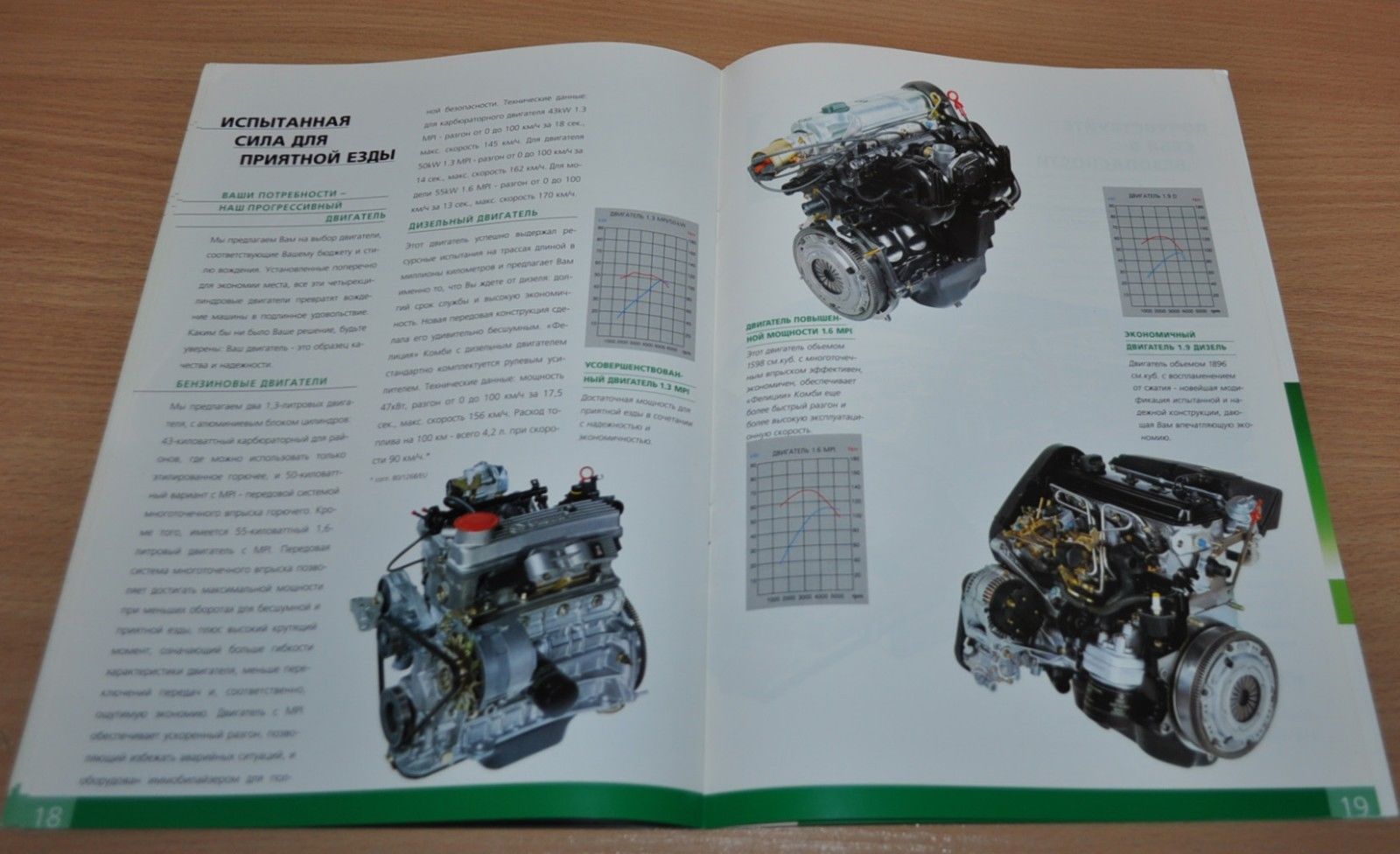
The undated Combi brochure names four engine offers. Its petrol classes distinguish carburettor feed from MPI; it gives no engine codes or controller, carburettor, injector or pump products. Language and the seller’s date do not establish a national market, manufacturer publication date or production limit.[16]
| Commercial class | Fuel supply / rated output | Source application |
|---|---|---|
| 1.3 carburettor | carburettor / 43 kW | Combi 1.3 carburettor |
| 1.3 MPI | multipoint petrol injection / 50 kW | Combi 1.3 MPI |
| 1.6 MPI | 1,598 cm³; [16]multipoint petrol injection / 55 kW | Combi 1.6 MPI |
| 1.9 D | 1,896 cm³; [16]diesel; exact pump/injector architecture unresolved / 47 kW | Combi 1.9 D |
Ecuadorian commercial engine identifiers
AEADE’s later used-market guide uses 1.3L and 1.6L capacity designations for the listed Combi, five-door GLX and single-cab Pickup classes. It does not identify their engine codes, output, fuel system or original assemblies. The written GLX 1.3p designation does not itself establish an engine-capacity specification; European code/output pairings must not be substituted.[17]
| Written commercial class | Source model-year entries |
|---|---|
| Felicia Combi 1.3L SW | 1995, 1996, 1997, 1998, 1999 |
| Felicia Combi 1.6L SW full | 1995, 1996, 1997, 1998, 1999 |
| Felicia GLX 1.3p 5p | 1995, 1996, 1997, 1998, 1999 |
| Felicia GLX 1.6L 5p A/A | 1995, 1996, 1997, 1998, 1999 |
| Felicia Pick up 1.3L P/U C/S | 1995, 1996, 1997, 1998, 1999, 2000, 2001 |
May 1995 Slovenian test engine class
The Gorenjski glas test specifies a front-transverse four-cylinder four-stroke petrol engine, 1,289 cm³ and 50 kW (68 KM), with electronic single-point injection, a catalyst and front-wheel drive. The technical panel lists 95-octane unleaded petrol. It identifies no engine code, injection supplier, ECU/calibration or complete assembly product. The power and architecture alone do not establish a 136B code.[52]
Caddy Pickup July 1996 technical engines
Volkswagen’s July 1996 Caddy Pickup specification identifies AEE petrol and AEF diesel engines. AEE is a 1,598 cm³ inline four with 9.8:1 compression and Magneti Marelli 1AV management. It records 55 kW at 4,500 rpm and 135 Nm at 3,500 rpm, with more than 120 Nm between 2,000 and 4,300 rpm. The stated fuel is 95 RON unleaded; 91 RON is permitted as a substitute with reduced power.[53]
The AEF entry is a 1,896 cm³ naturally aspirated swirl-chamber diesel with 22.5:1 compression and a Lucas distributor injection pump. It records 47 kW at 4,300 rpm and 124 Nm at 3,000 rpm, with more than 120 Nm between 2,000 and 3,500 rpm; the minimum stated cetane number is 49. The Lucas name does not identify a DPC subtype, calibration or complete pump product.[53]
These entries identify the AEE technical selection and the AEF technical selection. They are distinct from the later UK brochure’s diesel ratings; differing rpm entries do not by themselves prove a production change. Exact engine and injection-assembly product numbers/suffixes and manufacturing application remain Unconfirmed.
Valve-component service selection
Valve, guide and stem-seal requirements distinguish supplier service candidates from original installation and from the separately homologated competition-engine components.
Israeli national model engine records
The Israeli administrative catalogue records engine-capacity, fuel and horsepower fields for national manufacturer/model selections. These values do not assign a Škoda engine code, fuel-metering architecture or physical engine assembly. The returned records do not specify the capacity unit or the horsepower measurement basis; the numerical fields below remain literal record values, without a kW/PS conversion. Rounded 1300/1600 entries are not replaced with 1289/1598.[54]
| National selection | Recorded years | Capacity field: nefah_manoa | Fuel field | Horsepower field: koah_sus |
|---|---|---|---|---|
| M/676/500 | 1998, 1999, 2000, 2001 | 1896 | Diesel | 64[54] |
| M/676/610 | 1998, 1999, 2000, 2001 | 1896 | Diesel | 64[54] |
| M/676/620 | 1996 | 1289 | Petrol | 0 recorded; rated output Unconfirmed[54] |
| P/676/230 | 1999, 2000, 2001 | 1896 | Diesel | 64[54] |
| P/676/240 | 1999, 2000 | 1896 | Diesel | 64[54] |
| P/676/260 | 1999, 2000, 2001 | 1289 | Petrol | 68[54] |
| P/676/280 | 1998, 1999, 2000, 2001 | 1598 | Petrol | 75[54] |
| P/676/290 | 1998, 1999, 2000 | 1598 | Petrol | 75[54] |
| P/676/300 | 1996, 1997 | 1289 | Unconfirmed | 0 recorded; rated output Unconfirmed[54] |
| P/676/310 | 1996, 1997 | 1289 | Unconfirmed | 0 recorded; rated output Unconfirmed[54] |
| P/676/320 | 1996, 1997 | 1300 | Unconfirmed | 0 recorded; rated output Unconfirmed[54] |
| P/676/330 | 1997, 1998, 1999 | 1289 | Unconfirmed | 0 recorded; rated output Unconfirmed[54] |
| P/676/340 | 1997, 1998 | 1289 | Unconfirmed | 0 recorded; rated output Unconfirmed[54] |
| P/676/350 | 1997, 1998 | 1598 | Unconfirmed | 0 recorded; rated output Unconfirmed[54] |
| P/676/360 | 1997, 1998 | 1598 | Unconfirmed | 0 recorded; rated output Unconfirmed[54] |
| P/676/400 | 1996, 1997, 1998, 1999, 2000 | 1896 | Diesel | 64[54] |
| P/676/410 | 1997, 1998, 2000 | 1289 | Petrol | 64[54] |
| P/676/420 | 1997, 1998 | 1896 | Unconfirmed | 0 recorded; rated output Unconfirmed[54] |
| P/676/430 | 1997, 1998 | 1896 | Unconfirmed | 0 recorded; rated output Unconfirmed[54] |
| P/676/1000 | 1996, 1997 | 1600 | Unconfirmed | 0 recorded; rated output Unconfirmed[54] |
| P/676/1010 | 1996, 1997 | 1598 | Unconfirmed | 0 recorded; rated output Unconfirmed[54] |
| P/676/1020 | 1996, 1997 | 1600 | Unconfirmed | 0 recorded; rated output Unconfirmed[54] |
| P/676/1030 | 1996, 1997 | 1598 | Unconfirmed | 0 recorded; rated output Unconfirmed[54] |
For example, model 410 retains a capacity value of 1289 and a horsepower value of 64; those fields are not changed to the values of model 260 or used to assign 135/136 engine codes. A designation containing 1.9D remains a designation when the separate fuel field is unknown. The 4X2 drive entry and automatic-transmission indicator do not identify the driven axle, gearbox product, ratios or manual selector.[54]
Norwegian October 1998 LXi 1.3 test
The BIL test describes a four-cylinder engine with aluminium construction, a camshaft beside the cylinders, pushrods and two valves per cylinder. Its technical panel gives 1,289 cm³, 50 kW at 5,000 rpm and 106 N·m at 2,600 rpm. The printed compression ratio is 9.5:1. These are attributed test specifications, not a demonstrated engine-code or calibration mapping.[55]
The ratio/output combination differs from the code-specific February 1997 technical table: that table assigns 9.5:1 to 135M and 10.0:1 to 136M. The Norwegian account names neither engine code nor fuel-metering architecture. No 135M/136M or SPI/MPI selection follows from its LXi grade.[56]
Romanian December 1996 advertised engine classes
The Compexit importer advertisement distinguishes a carburettor-fed LX 1.3 rated at 40 kW, an injected LXi 1.3 rated at 50 kW, and injected 1.6-litre GLX and Combi LX offers rated at 55 kW. It expressly lists a catalyst for both 1.6-litre offers. The injected rows do not identify single-point or multipoint metering.[57]
| Source application | Engine class | Exact selection |
|---|---|---|
| LX 1.3 passenger offer | 1.3 litres; carburettor; 40 kW[57] | Engine code, carburettor/calibration and complete product Unconfirmed |
| LXi 1.3 passenger offer | 1.3 litres; injection; 50 kW[57] | Engine code, metering architecture, controller and complete product Unconfirmed |
| GLX 1.6 passenger offer | 1.6 litres; injection and catalyst; 55 kW[57] | Engine code, metering/catalyst products and complete product Unconfirmed |
| Combi LX 1.6 offer | 1.6 litres; injection and catalyst; 55 kW[57] | Engine code, metering/catalyst products and complete product Unconfirmed |
Publication on 24 December 1996 does not establish a manufacturing change, nationwide availability interval or original parts boundary. No engine code is inferred from output, capacity or an injection label.
DVSA body-selected engine designations
The British emissions reference writes the four 1.3-litre designations as 781.135B, 781.136B, 781.135M and 781.136M, and the 1.6-litre designation as AEE. Engine/body applications and test conditions are selected separately; this reference does not supply a complete physical engine product, output calibration or manufacturing boundary.[58]
The short VIN labels EEF and EFF recur with both B and M designations. They do not independently distinguish the engine version. The reference identifies the engine designation on the cylinder block but does not locate its three-character VIN labels in a complete VIN.[58]
Romanian February 1997 engine offers
The Compexit advertisement identifies separate Felicia 1.3- and 1.6-litre offers. The injection-and-catalyst description follows the 1.6-litre row. The 1.3-litre row does not identify its fuel system. Neither row supplies an engine code, rated output or manufacturing boundary.[59]
| Source application | Recorded engine class | Physical selection |
|---|---|---|
| Felicia 1.3 offer | 1.3-litre designation; fuel system unspecified[59] | Engine code, rated output, metering, calibration and complete engine product Unconfirmed |
| Felicia 1.6 offer | 1.6-litre designation; injection and catalyst[59] | Engine code, rated output, injection architecture, catalyst product and complete engine Unconfirmed |
Russian November 1997 LX carburettor engine
The Russian-market LX hatchback tested in November 1997 has the following source-defined carburettor engine. The report does not identify its engine code or carburettor type suffix. Pierburg’s name and automatic starting enrichment do not establish identity with the separately homologated Pierburg 2E3 selection.[60]
| Property | Source-scoped specification |
|---|---|
| Displacement / cylinder count | 1,289 cm³; four[60] |
| Recorded compression ratio | 8.8:1[60] |
| Rated output | 40 kW at 5,000 rpm; the test also prints 54 horsepower[60] |
| Maximum torque | 94 N·m at 2,250 rpm[60] |
| Block and cylinder head | Aluminium-alloy block and aluminium head[60] |
| Valve operation | Camshaft in the block; pushrods operating overhead valves[60] |
| Camshaft drive | Chain; the test describes no chain tensioner[60] |
| Fuel metering | Pierburg carburettor; complete type, product number and calibration Unconfirmed[60] |
| Starting enrichment | Automatic starting device; the account describes no manually operated choke closure[60] |
| Engine code and manufacturing selection | Unconfirmed[60] |
These descriptions do not identify particular block, head, camshaft, chain or carburettor production products. The report’s observations of chain noise on used cars do not establish a universal replacement interval.[60]
Russian November 1997 catalogue engine labels
The November 1997 Moscow price catalogue supplies petrol capacity and power labels, without engine codes or fuel-metering details. Its horsepower heading does not specify an engineering test convention; the numbers are retained without conversion to a particular kW calibration.[61]
| Named price class | Recorded engine label |
|---|---|
| 1.3 LX hatchback; 1.3 LX/GLX estates | Four cylinders; 1,289 cm³; written power 55 horsepower[61] |
| 1.3 LXi estate | Four cylinders; 1,289 cm³; written power 68 horsepower[61] |
| 1.6 GLX hatchback and estate | Four cylinders; 1,598 cm³; written power 75 horsepower[61] |
| Ambiguous 1.3 “X” estate entry | Four cylinders; 1,289 cm³; written power 55 horsepower; complete grade identity Unconfirmed[61] |
The catalogue’s 55-horsepower LX label differs from the same issue’s LX test notation of 40 kW/54 horsepower. The two descriptions do not establish separate calibrations or identical physical builds. The “i” in LXi is not used alone to assign an injection layout or engine code.[61][62]
Russian November 1997 dealer engine descriptions
The dealer advertisements distinguish fuel-supply descriptions and written engine ratings. Their production-year field is an advertised year; it does not identify an exact engine, calibration or factory production boundary. The source’s injection flag does not distinguish single-point from multipoint metering.[63]
| Advertised class | Source description |
|---|---|
| Advertised 1997 LX 1.6 hatchback | Injection flag; written capacity 1,598 cm³ and power 75 horsepower[63] |
| Advertised 1997 LX 1.3 hatchback | Carburettor flag; written capacity 1,289 cm³ and power 58 horsepower[63] |
| Advertised 1998 LX 1.9 hatchback/Combi offer | Diesel flag; written capacity 1,900 cm³ and power 64 horsepower[63] |
| Advertised 1998 LX 1.3 hatchback/Combi offer | Carburettor flag; written capacity 1,300 cm³ and power 59 horsepower[63] |
The horsepower figures retain the publication’s wording without an assumed test standard or kW conversion. Written 1,900 and 1,300 cm³ labels are not substituted for exact workshop displacements. No AEF, AEE, 135/136 suffix or carburettor product identity follows from these labels.[63]
Russian July 1998 catalogue engine classes
The July 1998 price table lists four LX body/capacity classes. Its triplets record cylinder count, engine capacity and power labels; the same issue’s dealer headings specify cm³ and horsepower. An engineering rating standard, engine code and metering architecture remain Unconfirmed.[64]
| Named class | Recorded label |
|---|---|
| LX 1.3 hatchback | Petrol flag; written triplet 4–1289–55[64] |
| LX 1.3 Combi | Petrol flag; written triplet 4–1289–55[64] |
| LX 1.6 hatchback | Petrol flag; written triplet 4–1598–75[64] |
| LX 1.6 Combi | Petrol flag; written triplet 4–1598–75[64] |
The petrol interpretation follows the publisher’s legend for the printed fuel flag. These price classes do not establish identity with a separately dated injection or carburettor-equipped dealer car, or extend that car’s fitted-part application.[64][65]
Russian 1998 dealer carburettor classes
The dealer tables retain different rounded capacity and horsepower labels. Neither assigns a complete engine code, carburettor product or calibration. The year is the advertisement’s production-year label, not a verified factory boundary. The written powers do not establish a rating standard or a new calibration.[66][67]
| Source-scoped vehicle class | Written engine description |
|---|---|
| July 1998, Pelikan LX hatchback | Advertised year 1998; written 1,300 cm³ / 59 horsepower; carburettor flag[67] |
| July 1998, Laurin i K LX hatchback | Advertised year 1998; written 1,289 cm³ / 58 horsepower; carburettor flag[67] |
| November 1998, Pelikan revised-front LX hatchback | Advertised year 1998; written 1,300 cm³ / 59 horsepower; carburettor flag[66] |
A matching label does not establish an identical installed engine or extend the equipment and parts application of another advertised car. No 135/136 suffix, Pierburg type or factory quantity is selected by these rows.[66][67]
Manufacturer historical-vehicle engine descriptions
| Manufacturer vehicle description | Reported intrinsic specification |
|---|---|
| Kit Car 1500, illustrated 1996 | Four cylinders; OHV; 1,491 cm³; 122 kW; source also writes 164 HP[68] |
| Combi LX (Policie), illustrated 1996 | Four cylinders; OHV; 1,289 cm³; 50 kW; source also writes 67 PS[68] |
| Golden Prague, illustrated 1998 | Four cylinders; OHC; 1,598 cm³; 55 kW; source also writes 75 PS[68] |
The timeline uses both HP and PS labels. These written figures are not recalculated into a calibration or a road engine-code mapping. The descriptions do not identify fuel metering, complete assembly products or manufacturing/chassis application. Similar capacity or output does not establish equivalence to a road 135/136 or AEE assembly, or a particular FIA kit.[68]
Dutch AutoWeek test engine descriptions
| Test designation and title label | Displacement | Rated output and speed | Peak torque and speed |
|---|---|---|---|
| Combi LXD 1.9 — title label 1997 | 1,896 cm³[69] | 47 kW at 4,300 rpm[69] | 124 Nm at 2,500 rpm[69] |
| Hatchback GLXi 1.3 — title label 1996 | 1,289 cm³[70] | 50 kW at 5,500 rpm[70] | 100 Nm at 3,750 rpm[70] |
| Combi GLXi 1.6 — title label 1996 | 1,598 cm³[71] | 55 kW at 4,500 rpm[71] | 135 Nm at 3,500 rpm[71] |
| Combi GLX 1.6 — title label 1999 | 1,598 cm³[72] | 55 kW at 4,500 rpm[72] | 135 Nm at 3,500 rpm[72] |
The LXD report describes a naturally aspirated, indirect-injection four-cylinder diesel. The GLXi 1.3 report describes an inline four-cylinder petrol engine with a light-alloy block and head and three crankshaft main-bearing positions; that count is not a quantity of loose bearing shells. It gives no fuel-metering architecture or engine code.[69][70]
The Combi GLXi 1.6 narrative names Volkswagen multipoint petrol injection and describes peak torque across 2,800–3,500 rpm; its current specification box records 3,500 rpm. The later GLX report identifies a transverse Volkswagen 1.6 petrol engine but does not name its injection system. Full engine, injector/controller and calibration identities remain Unconfirmed; similar ratings do not establish physical assembly equivalence.[71][72]
Czech-language manufacturer technical sheets, 1995
| Source engine class | Cylinder geometry | Compression ratio | Output and speed | Torque and speed | Written unleaded-fuel octane designation |
|---|---|---|---|---|---|
| Bosch Mono-Motronic 40 kW class | 1,289 cm³; 75.5 mm bore × 72 mm stroke | 8.8:1 | 40 kW at 5,000 rpm | 94 Nm at 3,250 rpm | 91[73][74] |
| Bosch Mono-Motronic 50 kW class | 1,289 cm³; 75.5 mm bore × 72 mm stroke | 9.7:1 | 50 kW at 5,500 rpm | 100 Nm at 3,750 rpm | 95[73][74] |
Both sheets describe a four-cylinder petrol engine mounted transversely ahead of the front axle. Its overhead-valve mechanism has a camshaft in the block driven by a chain. Bosch Mono-Motronic mixture preparation and a three-way catalyst are specified. These names and ratings do not identify complete engine, injection, controller, chain or catalyst products, calibration, or a production/VIN selection.[73][74]
The grade headings associate 40 kW with LX and GLX, and 50 kW with LXi and GLXi, separately in each body sheet. No full engine code is printed; the descriptions do not establish a 135B/136B product identity or an MPI equivalence. The fuel numbers are the sheets’ written unleaded-petrol octane designations; the source specification does not name an octane measurement standard.[73][74]
September 1996 ŠkoFIN engine designations
The September 1996 illustration identifies some offers by output and others by commercial engine designation. These are different selector fields: 40/50 kW does not supply a capacity or injection system, and the written 1.6/1.9 D labels do not supply an output or physical engine code. No SPI/MPI, road-engine code or calibration is assigned from another publication.[75]
| Written selector | Meaning and unresolved physical identity | Source-defined applications |
|---|---|---|
| 40 kW | Written rated-output label; capacity, fuel, metering, compression and full engine product Unconfirmed[75] | Felicia LX; Felicia Combi LX; Felicia PICK-UP LX; Felicia VANPLUS LX |
| 50 kW | Written rated-output label; capacity, fuel, metering, compression and full engine product Unconfirmed[75] | Felicia LX; Felicia GLX; Felicia Combi LX; Felicia Combi GLX; Felicia PICK-UP LX; Felicia VANPLUS LX |
| 1.6 | Written commercial capacity/designation label; rated output, metering, calibration and full engine product Unconfirmed[75] | Felicia LX; Felicia GLX; Felicia Combi LX; Felicia Combi GLX; Felicia PICK-UP LX; Felicia VANPLUS LX |
| 1.9 D | Written commercial capacity/designation label; rated output, metering, calibration and full engine product Unconfirmed[75] | Felicia LX; Felicia GLX; Felicia Combi LX; Felicia Combi GLX; Felicia PICK-UP LX; Felicia VANPLUS LX |
Swedish model-year engine designations
The Swedish records identify their engines by nominal commercial labels. Their grade names do not identify single-point versus multipoint injection, and a capacity designation does not select an original engine or controller. Only the 2001 names append the written output labels 68hk, 75hk or 64hk; those descriptors do not establish a kW rating, measurement standard, rated speed or calibration.[76]
Turkish 2001 commercial engine designations
The 2001 Turkish import-sales table uses the written engine designations 1,3 and 1,6 for Felicia and Felicia Combi. These nominal model labels do not establish an engine code, injection system, rated output, calibration or complete original assembly.[77]
| Written designation | Physical selection | Named model applications |
|---|---|---|
| 1,3 | Commercial model label; exact engine, fuel system, capacity/output/calibration and original product Unconfirmed | Škoda Felicia 1.3 — Turkey 2001 import-sales class; Škoda Felicia Combi 1.3 — Turkey 2001 import-sales class |
| 1,6 | Commercial model label; exact engine, fuel system, capacity/output/calibration and original product Unconfirmed | Škoda Felicia 1.6 — Turkey 2001 import-sales class; Škoda Felicia Combi 1.6 — Turkey 2001 import-sales class |
VIN and data-label engine selection
Starter selection
Alternator selection
Slovenian November 1995 Combi engine
The technical panel records a 1,289 cm³, four-cylinder, four-stroke in-line petrol engine, mounted transversely at the front and rated at 50 kW. The prose reports electronic fuel injection but does not identify an engine suffix, metering architecture, calibration or factory engine product.[78]
Slovenian August 1999 Fun engine
The period panel records a four-cylinder, four-stroke in-line petrol engine mounted transversely at the front and rated at 55 kW. Its displacement is printed as 1,589 cm³, while the model designation is 1.6. The later manufacturer account gives 1,598 cm³ for the series-level 55 kW Fun engine. The differing figures do not establish a separate 1,589 cm³ production variant or identify the Slovenian car’s complete engine code or calibration.[79][80]
Slovenian December 1996 and February 1997 diesel tests
The December 1996 Pickup report gives a 1,896 cm³, four-cylinder, four-stroke in-line diesel rated at 47 kW and mounted transversely at the front. The February 1997 GLX hatchback report identifies a nominal 1.9-litre diesel at the same output. These descriptions do not identify complete original engine units, fuel-system products or calibration/production selectors.[81][82]
Slovenian February 1995 launch offers
The February account records a 1,289 cm³ four-cylinder engine at 40 kW and 5,000 rpm or 50 kW and 5,500 rpm. It explicitly assigns the stronger version to LXi and GLXi. Its printed 40 kW / 52 KM pairing is inconsistent with the usual metric-horsepower conversion; it does not establish a separate 52 KM calibration. Complete engine suffixes and fuel-metering/calibration products are not identified.[83]
Slovenian September 1995 Combi offers
The September account describes the 1.3-litre family at 40 or 50 kW but does not map those outputs to the two published Combi grade/price lines. The planned 1.6-litre and diesel additions do not establish either engine on those priced vehicles. No hatchback grade-to-output mapping is transferred to these estate offers.[84]
Hungarian November 1998 dealer engine classes
The dealer display list names 1.6-litre Felicia LX and Combi LX, a 1.9 D Felicia LX and a 1.3-litre Pickup. It supplies no output, complete engine code, physical engine identity or metering/calibration selection. Generic Felicia family specifications do not identify the individual advertised units.[85]
- Škoda Felicia LX 1.6 in rally red
- Škoda Felicia Combi LX 1.6 in ocean green metallic
- Škoda Felicia LX 1.9 D in chili red metallic
- Škoda Felicia Pickup 1.3 with driver airbag and steering assistance
Italy: February 1995 launch offers — engine selections
The February launch advertisement identifies LX at 54 CV and GLX at 68 CV. It does not state kW, displacement, injection type or full engine codes. The intended November 1994 launch specification is a separate dated account; it is not used to supply unreported identities to these priced rows.[86]
Italy: January 1998 offers — engine selections
The January programme names 1.3 LX, 1.3 GLX, 1.6 GLX, 1.9 D LX and 1.9 D GLX in each passenger body. It does not give rated outputs, engine product codes, injection architecture or gearbox assemblies. The output of a later similarly named offer does not establish a January specification.[87]
- Škoda Felicia Hatchback LX 1.3
- Škoda Felicia Hatchback GLX 1.3
- Škoda Felicia Hatchback GLX 1.6
- Škoda Felicia Hatchback LX 1.9 D
- Škoda Felicia Hatchback GLX 1.9 D
- Škoda Felicia Combi LX 1.3
- Škoda Felicia Combi GLX 1.3
- Škoda Felicia Combi GLX 1.6
- Škoda Felicia Combi LX 1.9 D
- Škoda Felicia Combi GLX 1.9 D
Italy: July 1998 offers — engine selections
The July programme records hatchback 1.3 LX at 40 kW/54 CV; hatchback 1.3 GLX and Combi 1.3 LX/GLX at 50 kW/68 CV; 1.6 GLX in both bodies at 55 kW/75 CV; and 1.9 D LX/GLX in both bodies at 47 kW/64 CV. The Combi LX therefore cannot inherit the hatchback LX output. Complete engine codes, injection assemblies and production selectors are not stated.[88]
- Škoda Felicia Hatchback LX 1.3 40 kW
- Škoda Felicia Hatchback GLX 1.3 50 kW
- Škoda Felicia Hatchback GLX 1.6 55 kW
- Škoda Felicia Hatchback LX 1.9 D 47 kW
- Škoda Felicia Hatchback GLX 1.9 D 47 kW
- Škoda Felicia Combi LX 1.3 50 kW
- Škoda Felicia Combi GLX 1.3 50 kW
- Škoda Felicia Combi GLX 1.6 55 kW
- Škoda Felicia Combi LX 1.9 D 47 kW
- Škoda Felicia Combi GLX 1.9 D 47 kW
Italian announced launch specification, November 1994
The November 1994 Italian launch preview assigns the intended LX/GLX programme 1,289 cm³ engines rated at 54/68 CV, respectively, with Bosch Monomotronic single-point injection, a three-way catalyst and lambda sensing. It describes front-wheel drive. The subsequent February price advertisement confirms the grade/output labels but does not restate this mechanical specification. The preview does not identify a complete engine or ECU product, calibration, gearbox or production boundary; planned later safety equipment is not a fitted configuration.[89]
Italian Wagon VAN 1.9 Diesel, September 1998
The leaflet’s engine is a transverse inline four-cylinder diesel of 1,896 cm³, with 79.5 mm bore, 95.5 mm stroke and 22.5:1 compression. It is rated at 47 kW/64 CV at 4,300 rpm. Maximum torque is recorded as 124 Nm with the written speed entry 2,500 / 3,200 rpm; that notation is retained without assigning an unreported torque curve.[90]
The OHC valve gear is driven by a toothed belt. Fuel delivery is indirect injection with an oxidation catalyst. Cooling is liquid-based with a thermostat-regulated fan; lubrication uses forced oil circulation and an oil filter. Fan drive, individual cooling controls, metering products and oil-filter identity are not identified. The leaflet does not supply an engine product code, calibration or gearbox; an AEF mapping from another Felicia source is not assigned to it.[90]
German Blue Sky source-rated engine, July 1998
The German Blue Sky leaflet gives the 1.6 L programme 1,598 cm³, 55 kW/75 PS at 4,500 rpm and 135 Nm at 3,500 rpm. It specifies unleaded fuel rated at 95 octane as written. The complete engine code, injection/calibration products and gearbox/drivetrain identities are Unconfirmed. These leaflet ratings are not used to infer an AEE stock assembly or to replace differently dated technical ratings.[91]
UK Moravia capacity class
Covéa’s May 2016 directory assigns Felicia Moravia a capacity of 1,289 cm³ and the written year range 96–96. This is an insurance vehicle-class description, without an engine code, rated output, calibration or fuel-metering product.[92]
The separate UK 2025 engine-band records use Petrol and the band 1,201–1,300 cm³. Their sorting value 1,300 is the band’s upper bound, not an exact measured engine displacement. These fields do not establish a B/M code or a 40/50 kW version; the installed engine, compression, injection architecture and original assembly remain Unconfirmed.[93][94]
August 1998 owner-manual engine selections
The August 1998 manual identifies five engine selections by capacity, output and fuel. Its engine table does not give the stamped engine codes or complete assembly numbers. The following specifications belong to those written selections; matching output alone does not establish a code, injection maker or physical assembly.[95]
1.3 / 43 kW
The four-cylinder 1.3 selection has 1,289 cm³ displacement and 8.8:1 compression. The manual rates it at 43 kW at 5,000 rpm, with peak torque of 94 N·m at 3,000 rpm. Its historical fuel specification is leaded or unleaded petrol; minimum octane number 90.[95]
1.3 MPI / 40 kW
The four-cylinder 1.3 MPI selection has 1,289 cm³ displacement and 9.5:1 compression. The manual rates it at 40 kW at 4,500 rpm, with peak torque of 99 N·m at 2,500 rpm. Its historical fuel specification is unleaded petrol; minimum octane number 91.[95]
1.3 MPI / 50 kW
The four-cylinder 1.3 MPI selection has 1,289 cm³ displacement and 10:1 compression. The manual rates it at 50 kW at 5,000 rpm, with peak torque of 106 N·m at 2,600 rpm. Its historical fuel specification is unleaded petrol; minimum octane number 95.[95]
1.6 MPI / 55 kW
The four-cylinder 1.6 MPI selection has 1,598 cm³ displacement and 9.8:1 compression. The manual rates it at 55 kW at 4,500 rpm, with peak torque of 135 N·m at 3,500 rpm. Its historical fuel specification is unleaded petrol; minimum octane number 95.[95]
1.9 D / 47 kW
The four-cylinder 1.9 D selection has 1,896 cm³ displacement and 22.5:1 compression. The manual rates it at 47 kW at 4,300 rpm, with peak torque of 124 N·m at 2,500–3,200 rpm. Its historical fuel specification is diesel; minimum cetane number 49.[95]
The 1.3-litre 43 kW entry does not state its fuel-metering assembly. The manual’s fuel footnote advises 95-octane petrol if the 43 kW or 40 kW selection knocks on fuel of insufficient anti-knock quality. Export or specially equipped vehicles can differ; their individual technical documentation takes precedence. Publication and portal grouping dates do not establish engine production cutoffs.[95]
See also
- Original parts by vehicle system
- AEF engine replacement
- Felicia homologation engine construction
- Models and identification
- Repairs and diagnostics
- Maintenance
Chilean assessment capacity class
The SII records use the nominal capacity label 1300 CC with the fuel selector BENC. That administrative description does not establish an exact measured 1300 cm³ displacement, a 1289 cm³ manufacturer engine, its code/output, injection architecture or a particular assembly.[18]
Colombian September 1996 report
The period GLX 1.6 description gives a front transverse four-cylinder engine, written displacement 1600 cm³ and output 69 horsepower. It does not identify the horsepower standard, test basis, fuel-metering system or manufacturer engine code. The report is not silently converted into an AEE/55 kW calibration or an exact 1598 cm³ assembly.[19]
November 1994 Spanish-language launch report
Motor16’s engine columns are labelled 135i and 136i. Both describe a front transverse four-cylinder 1289 cm³ engine with two valves per cylinder and electronic injection. The 135i column gives 54 CV at 5000 rpm and 8.8:1 compression; 136i gives 68 CV at 5500 rpm and 9.7:1. Both are described as catalysed. The text does not identify a supplier/metering architecture or explicitly equate those written labels with 135B/136B, and does not map LX/GLX grades to the two columns.[20]
Greek June 1996 GLXi test engine class
The paired GLXi 1.6 test specification describes a front transverse four-cylinder 1598 cm³ petrol engine with a cast-iron block, aluminium head, one overhead camshaft and two valves per cylinder. Fuel metering is electronic multipoint injection. The report gives 75 ECE horsepower at 4500 rpm, bore/stroke 76.5 × 86.9 mm and compression 9.8:1. The engine code, block/head products and calibration identities are Unconfirmed; the technical table does not select the separately priced Combi LXi assembly.[21]
Greek June 1996 Pickup engine class
The separately described ordinary Pickup uses the written 1.3 designation and 68-horsepower label. The passage does not give a horsepower standard, manufacturer engine code, exact capacity, fuel-metering product or gearbox selection. The 1.6 GLXi specifications do not apply to this Pickup.[22]
Greek 1995 GLXi engine class
The March GLXi test specifies an aluminium 1289 cm³ engine with two valves per cylinder and a block-mounted camshaft, using Bosch electronically controlled single-point injection. It reports 68 horsepower at 5500 rpm and 10.2 kg·m at 3750 rpm. Horsepower standard, full engine/ECU/injector identities, calibration and a manufacturer engine-code mapping remain Unconfirmed.[23]
The April Greek GLXi comparison independently describes the same single-point Bosch architecture and publishes the 10.1 kg·m torque value; it does not identify a different engine or calibration.[24]
Greek summer 1998 GLX engine class
The GLX comparison describes a four-cylinder 1289 cm³ aluminium engine with a block-mounted camshaft and two pushrod-operated valves per cylinder. Its reported maximums are 68 horsepower at 5000 rpm and 10.8 kg·m at 2600 rpm. It does not specify the injection supplier/architecture, horsepower standard, original engine/calibration or code; those are not inferred from output or the revised body.[25]
Greek November 1999 MPI engine class
The five-door test uses the written 1.3 designation and describes an inline four-cylinder engine with aluminium block/head, a block-mounted camshaft, pushrods and two valves per cylinder. It explicitly identifies multipoint injection and reports 68 horsepower at 5000 rpm and 10.8 kg·m at 2600 rpm. Full manufacturer code, capacity measurement, metering products and calibration are Unconfirmed. The report’s connection between MPI and the preceding body refresh does not establish a universal manufacturer introduction date.[26]
March 1995 Slovenian GLXi engine class
The test panel records a front transverse four-cylinder 1289 cm³ engine with bore/stroke 75.5 × 72.0 mm, compression 9.7:1 and rated output 50 kW at 5500 rpm. It gives 100 N·m at 3750 rpm, light-alloy block/head, five crankshaft bearing positions, one chain-driven block camshaft, two valves per cylinder, Bosch Monomotronic single-point injection/electronic ignition and a regulated exhaust catalyst. The stated 6 L cooling and 4 L engine-oil capacities are published system figures, not independently verified drain/refill instructions. Manufacturer engine/product codes, ECU/injector calibration, bearing-shell quantities and build/option limits are Unconfirmed.[27]
June 1995 Combi 1.3 launch-table classes
The Combi LX/GLX column records two four-cylinder 1289 cm³ engine/output classes without mapping the grade to the output: 40 kW at 5000 rpm with 8.8:1 compression and 94 N·m; and 50 kW at 5500 rpm with 9.7:1 and 100 N·m at 3750 rpm. The bore/stroke is 75.5 × 72.0 mm. The grouped column describes two valves per cylinder and electronic fuel injection/ignition; the accompanying text describes single-point injection for the 1.3 engine. Complete engine/metering products, codes and grade-specific calibrations are Unconfirmed.[28]
June 1995 Combi 1.6 launch class
The Combi 1.6 LX/GLX/SLX column records a four-cylinder 1598 cm³ class with bore/stroke 76.5 × 86.9 mm, compression 9.8:1, 55 kW at 4500 rpm and 135 N·m at 3500 rpm. The driven GLX 1.6 is explicitly described with Volkswagen electronic multipoint injection. Its code, original metering/calibration and the precise LX/SLX fuel-system products remain Unconfirmed. The table’s shared block-camshaft/chain line does not independently identify the 1.6 architecture or establish valvetrain equivalence with the 1.3 column.[29]
February 1995 Spanish GLX test engine
The technical panel describes a front transverse inline-four 1289 cm³ engine, light-alloy block/head, one side/block-mounted camshaft and two valves per cylinder. It gives bore/stroke 75.5 × 72.0 mm, compression 9.7:1, 68 CV (50 kW) at 5500 rpm, and 100 N·m at 3750 rpm. Fuel is specified as 95-octane unleaded petrol. The panel says electronic injection; the prose names Bosch Motronic without a complete metering/ECU product or a manufacturer engine-code mapping. No SPI/MPI or later code equivalence is inferred from that written family name.[30]
April 1995 recap of the GLX test
The recap explicitly identifies test issue 591 but gives the maximum-torque speed as 4000 rpm rather than the original panel’s 3750 rpm. That editorial difference does not establish a distinct engine, calibration, production revision or revised manufacturer torque curve.[31]
May 1995 Spanish price-list engine labels
The three price entries use the 1.3/1289 cm³ capacity label. LXi is listed at 54 CV; LXi Plus and GLXi at 68 CV. The guide legend identifies the power column as DIN horsepower. Those labels do not supply manufacturer engine codes, an injection architecture, ECU/calibration identity or physical equivalence with the February GLX test engine.[32]
June 1995 Combi 1.3 launch columns
The two front transverse inline-four columns give 1289 cm³, two valves per cylinder and single-point injection. The 54 CV column states 5000 rpm, 8.8:1 compression and 9.6 mkg at 3250 rpm; the 68 CV column gives 5500 rpm, 9.7:1 and 10.2 mkg at 3750 rpm. These are source-written figures; manufacturer engine/metering codes and grade-specific assemblies are Unconfirmed.[33]
June 1995 Combi 1.6 launch column
The front transverse inline-four 1598 cm³ column gives two valves per cylinder, multipoint injection, compression 9.8:1 and 75 CV at 4500 rpm. It gives 13.7 mkg at 3500 rpm, while the adjoining driving prose gives 3750 rpm. That disagreement is not resolved into a factory calibration or product distinction. The account identifies Volkswagen engine origin without supplying a manufacturer engine code, a complete assembly or a proven SLX pairing.[34]
Budapest 1995 report: engine outputs
The show report names LX at 40 kW, and LXi/GLXi at 50 kW. It gives no displacement, power-speed standard, complete engine code, gearbox or grade-to-body mapping. Its written injection/catalyst description does not identify a full fuel-metering product or calibration.[35]
Portuguese 1997–1998 advertised engine-capacity classes
The named hatchback and Break 1.3 GLXi offers each state 1289 cm³; the two 1.9 GLXD offers each state 1896 cm³. The capacity boxes give no output, full engine code, fuel-metering product or calibration. The grade lettering and a later unallocated range promotion do not establish an MPI, AEE or AEF product mapping.[36]
Swiss approved 136B engine classes
These values belong to the listed Swiss approvals. Code/output equivalence does not resolve a full engine assembly, calibration, gearbox or original production application.
| Approval class | Engine marking | Capacity | Rated output | Maximum torque |
|---|---|---|---|---|
| CH 1S2509 | 781.136B | 1288.71 cm³ | 50 kW at 5500 rpm | 100 N·m at 3750 rpm[37] |
| CH 1S2510 | 781.136B | 1288.71 cm³ | 50 kW at 5500 rpm | 100 N·m at 3750 rpm[38] |
| CH 1SC307 | 781.136B | 1289 cm³ | 50 kW at 5500 rpm | 100 N·m at 3750 rpm[39] |
| CH 1SC308 | 781.136B | 1289 cm³ | 50 kW at 5500 rpm | 100 N·m at 3750 rpm[40] |
| CH 3SH101 | 781.136B | 1289 cm³ | 50 kW at 5500 rpm | 100 N·m at 3750 rpm[41] |
Swiss approved 136M engine classes
These values belong to the listed Swiss approvals. Code/output equivalence does not resolve a full engine assembly, calibration, gearbox or original production application.
| Approval class | Engine marking | Capacity | Rated output | Maximum torque |
|---|---|---|---|---|
| CH 1SC305 | 781.136M | 1289 cm³ | 50 kW at 5000 rpm | 106 N·m at 2600 rpm[42] |
| CH 1SC306 | 781.136M | 1289 cm³ | 50 kW at 5000 rpm | 106 N·m at 2600 rpm[43] |
| CH 3SH103 | 781.136M | 1289 cm³ | 50 kW at 5000 rpm | 106 N·m at 2600 rpm[44] |
Swiss approved AEE engine classes
These values belong to the listed Swiss approvals. Code/output equivalence does not resolve a full engine assembly, calibration, gearbox or original production application.
| Approval class | Engine marking | Capacity | Rated output | Maximum torque |
|---|---|---|---|---|
| CH 1SC301 | AEE | 1598 cm³ | 55 kW at 4500 rpm | 135 N·m at 3500 rpm[45] |
| CH 1SC302 | AEE | 1598 cm³ | 55 kW at 4500 rpm | 135 N·m at 3500 rpm[46] |
| CH 1SC313 | AEE | 1598 cm³ | 55 kW at 4500 rpm | 135 N·m at 3500 rpm[47] |
Swiss approved AEF engine classes
These values belong to the listed Swiss approvals. Code/output equivalence does not resolve a full engine assembly, calibration, gearbox or original production application.
| Approval class | Engine marking | Capacity | Rated output | Maximum torque |
|---|---|---|---|---|
| CH 1SC303 | AEF | 1896 cm³ | 47 kW at 4300 rpm | 124 N·m at 2500 rpm[48] |
| CH 1SC304 | AEF | 1896 cm³ | 47 kW at 4300 rpm | 124 N·m at 2500 rpm[49] |
| CH 1SC314 | AEF | 1896 cm³ | 47 kW at 4300 rpm | 124 N·m at 2500 rpm[50] |
| CH 3SH102 | AEF | 1896 cm³ | 47 kW at 4300 rpm | 124 N·m at 2500 rpm[51] |
References
- ↑1 Škoda Auto. Celebrating 30 years of the Škoda Felicia. 22 October 2024, section on the original range and engine additions. Accessed .
- ↑1 ↑2 ↑3 Škoda Auto PR Portal Polska. Dwie dekady koncernowych silników w samochodach marki ŠKODA. 28 July 2015; Felicia engine chronology, body types and 1.3 fuel-system description. It dates the 1.6 to 1995 and the 1.9 D to 1996. Accessed .
- ↑1 ↑2 Tomasz Orlik, Škoda Auto PR Portal Polska. Dwie dekady koncernowej ŠKODY Felicia. 9 September 2014; its retrospective associates both larger engine additions with the 1995 season and says the 1.9 D followed the 1.6 later, without specifying a separate year. Accessed .
- ↑1 Škoda Auto. Anniversary: 25 years of the ŠKODA FELICIA. 15 October 2019. Accessed .
- ↑1 ↑2 ↑3 ↑4 Mark Coombs and R. M. Jex. Skoda Felicia Service and Repair Manual. J. H. Haynes & Co. Ltd., manual 3505, title-page copyright 2003, ISBN 9780857337498. Chapter 2, Part A: specifications, printed page 2A•1; section 1, engine description, printed pages 2A•2–3.
- ↑1 ↑2 Coombs and Jex. Skoda Felicia Service and Repair Manual. Haynes manual 3505, title-page copyright 2003, ISBN 9780857337498. Chapter 2, Part B: specifications, printed page 2B•1; section 1, engine description, printed page 2B•3.
- ↑1 ↑2 ↑3 Coombs and Jex. Skoda Felicia Service and Repair Manual. Haynes manual 3505, title-page copyright 2003, ISBN 9780857337498. Chapter 2, Part C: specifications, printed page 2C•1; section 1, engine description, printed page 2C•3.
- ↑ ↑1 ↑2 ↑3 Jiří Schwarz. Škoda Felicia 1994–2001: Opravy a údržba. Grada Publishing, first edition, 2015, ISBN 978-80-247-3657-0; publication authorised by ŠKODA AUTO a.s. Section 1.3.2, printed p. 18; the technical data are stated to apply to the vehicle specification of 02/1997. Publisher-hosted preview PDF. Accessed .
- ↑1 ↑2 ↑3 ↑4 ↑5 Škoda Auto. Dutch-language Felicia and Felicia Combi brochures, January 1997 imprints FC 017 33 and FCK 024 A 33. Combined preserved PDF, hatchback pp. 2, 4 and 8 (PDF pp. 2, 4 and 8), Combi pp. 6 and 8 (PDF pp. 14 and 16); grade/output/fuel-system columns, suspension/brakes, assistance and roof-carrier conditions. Original brochures preserved by AutoWeek. Accessed .
- ↑1 Škoda Auto. Dutch-language Felicia brochure, imprint FC 037 45, 1/95, PDF pp. 6–8; standard restraints, named engine/grade columns, transmission and suspension/brakes. Original brochure preserved by AutoWeek. Accessed .
- ↑1 Škoda Auto. German-language Felicia Fun leaflet, imprint FC 052 00, 9/97, PDF p. 6; 1.6 MPI specification and convertible 2+2 seating description. Original leaflet preserved by AutoWeek. Accessed .
- ↑1 Škoda Auto. German Felicia Fun leaflet, March 1999 imprint, PDF p. 2; technical panel, 2+2 seating, radio/leather optional-equipment caption and German manufacturer website. Preserved original leaflet. The archive watermark is separate from the manufacturer content. Accessed .
- ↑1 Pon Mobiel BV. Škoda prijzen per 1 februari 1995, PDF p. 1; Felicia five-door hatchback prices and regulated three-way catalyst/lambda-sensor E-2 statement. Original importer price list preserved by AutoWeek. Accessed .
- ↑1 L’argus. Felicia 1.3 54ch Special catalogue record; Felicia 1.3 68ch Confort catalogue record; Felicia 1.6 75ch Confort catalogue record; Felicia 1.9 D Confort catalogue record; Felicia 1.3 80ch Sporty catalogue record. Later specification entries, publication dates unspecified. Accessed .
- ↑1 Car Keys Team. Skoda Felicia 1.3 Popular. Road test, published 24 July 2000; updated 7 June 2017. UK Popular body availability and reported equipment. Accessed .
- ↑3 ↑2 ↑1 Škoda Auto. Felicia Combi, undated Russian-language manufacturer brochure, printed pp. 18–19, petrol and diesel engine descriptions. Consulted in the public brochure listing and its photograph of the engine chapter. The seller’s date is not a checked manufacturer imprint; Russian language does not establish a national sales market. Accessed .
- ↑1 Asociación de Empresas Automotrices del Ecuador (AEADE), Hugo Vargas Egüez. Guía Nacional del Mercado de Vehículos Usados: Livianos y Pesados, 15th edition, May 2015, printed pp. 386–387 (PDF pp. 388–389), Škoda entries. Later used-market classification; the listed years are not factory production, option or parts-change boundaries. Accessed .
- ↑ Servicio de Impuestos Internos (SII), Chile. Vehículos livianos 2006, January 2006, printed/PDF p. 28, printed/PDF p. 39, Škoda assessment classifications. Tax assessment years and codes are not manufacturer build, equipment or part identifiers. Accessed .
- ↑ Redacción Semana. A toda máquina, edition 746, 16 September 1996, Colombian-market Felicia GLX 1.6 specification and paint-price passage. Period press report; no manufacturer component identifiers. Accessed .
- ↑ S. G. P., Motor16. Škoda Felicia: Viento del este, issue 578, 15 November 1994, printed pp. 26–30 and 32 (PDF pp. 14–17), especially the engine comparison and launch offer on p. 32. The consulted cover supplies the issue/date; the archive filename does not. Accessed .
- ↑ 4Troxoi. Skoda Felicia 1.6, June 1996; publisher’s 4tLibrary archive. Mechanical-parts and equipment discussion, paired GLXi test specification, Pickup passage and Greek price entries. Test-car observations are not universal Greek-market fitment. Accessed .
- ↑ 4Troxoi. Skoda Felicia 1.6, June 1996; publisher’s 4tLibrary archive. Mechanical-parts and equipment discussion, paired GLXi test specification, Pickup passage and Greek price entries. Test-car observations are not universal Greek-market fitment. Accessed .
- ↑ 4Troxoi. Skoda Felicia GLXi, March 1995, publisher’s 4tLibrary archive; engine, transmission, running gear and tested equipment. Test observations do not establish universal grade fitment. Accessed .
- ↑ 4Troxoi. Skoda Felicia 1.3 – Hyundai Accent 1.3, April 1995, publisher’s 4tLibrary archive; GLXi comparison, engine, body and tested interior/equipment. Test observations do not establish universal grade fitment. Accessed .
- ↑ 4Troxoi. Daewoo Lanos 1.4 5d SE – Skoda Felicia 1.3 GLX, July 1998, publisher’s 4tLibrary archive; GLX test, engine, suspension and offer equipment. Test observations do not establish universal grade fitment. Accessed .
- ↑ 4Troxoi. Hyundai Accent 1.3 – Skoda Felicia 1.3 – Suzuki Baleno 1.3, November 1999, publisher’s 4tLibrary archive; tested five-door MPI and fitted safety/comfort equipment; grade not identified. Test observations do not establish universal grade fitment. Accessed .
- ↑ Andrej Šupe, photography Tomi Lombar. Škoda Felicia GLXi, Avto magazin, 16 March 1995; original test PDF, PDF pp. 3–4, technical panel printed p. 21. The prose and panel disagree about steering assistance. Accessed .
- ↑ Mitja Gustinčič. Škoda Felicia Combi GLX 1.6: Vrednost prostora, Avto magazin, 22 June 1995; original launch-drive PDF, printed/PDF pp. 18–19 / 1–2. Technical table and GLX 1.6 drive; Slovenian prices were not yet set. Accessed .
- ↑ Mitja Gustinčič. Škoda Felicia Combi GLX 1.6: Vrednost prostora, Avto magazin, 22 June 1995; original launch-drive PDF, printed/PDF pp. 18–19 / 1–2. Technical table and GLX 1.6 drive; Slovenian prices were not yet set. Accessed .
- ↑ Juan Luis Soto, photography José Antonio Díaz, Motor16. Interés fijo, issue 591, 14 February 1995, printed pp. 22–31 (PDF pp. 12–16), especially the technical/equipment panel on p. 27 and Spanish importer/offer discussion on pp. 28–29. Native cover and printed byline identify the issue and author. Accessed .
- ↑ Motor16. Interés fijo, test recap, issue 600, 18 April 1995, printed p. 113 (PDF p. 53). The recap explicitly identifies the original test as issue 591; its torque speed and front-brake description differ from the original. Accessed .
- ↑ Motor16. Precios: Škoda, issue 606, 30 May 1995, printed pp. 59 and 66 (PDF pp. 27 and 29), price-guide legend and three Felicia price/specification/option entries. The legend defines the airbag column as driver-side equipment and the CV field as DIN horsepower. Native cover supplies issue/date; the archive filename does not. Accessed .
- ↑ Víctor Piccione, Motor16. Skoda Combi: Familiar de bolsillo, issue 608, 13 June 1995, printed pp. 12–14 and 16 (PDF pp. 7–9), three engine columns, Combi equipment and 1.6 launch drive. Spanish arrival in September is a forecast, not a delivered national configuration. Accessed .
- ↑ Víctor Piccione, Motor16. Skoda Combi: Familiar de bolsillo, issue 608, 13 June 1995, printed pp. 12–14 and 16 (PDF pp. 7–9), three engine columns, Combi equipment and 1.6 launch drive. Spanish arrival in September is a forecast, not a delivered national configuration. Accessed .
- ↑ Károly Varga. Beszámoló az Autómobil 95 járműipari szakkiállításról. Közlekedéstudományi Szemle, XLVI, no. 2, February 1996; printed pp. 58–63 (PDF pp. 20–25), event dates on p. 58, importer context on pp. 59 and 63, Felicia grade/output and injection/catalyst passage on p. 63. Accessed .
- ↑ Carlar / SIVA. Felicia and Felicia Break advertisement. ELO, year XXIII, no. 267, August 1997, printed/PDF p. 11; four body/grade/capacity price boxes and common equipment/option text. Associação dos Deficientes das Forças Armadas; retained by the University of Coimbra, Centro de Documentação 25 de Abril. Accessed .
- ↑1 Swiss Federal vehicle-approval record. CH 1S2509 — Felicia, approved 6 March 1995, replacement print 28 March 1996; manufacturer/type/engine, chassis, silencer, equipment, emissions and wheel-variant fields, single-page original. ASTRA open-data archive. Accessed .
- ↑1 Swiss Federal vehicle-approval record. CH 1S2510 — Felicia Combi, approved 6 March 1995, replacement print 28 March 1996; manufacturer/type/engine, chassis, silencer, equipment, emissions and wheel-variant fields, single-page original. ASTRA open-data archive. Accessed .
- ↑1 ASTRA. CH 1SC307 — Felicia, German/French type-approval record; identification, engine/exhaust, chassis, gearbox/emissions and remarks fields. Approval 1997-01-21; last-change field not populated. Approval dates do not delimit manufacture or original parts. Accessed .
- ↑1 ASTRA. CH 1SC308 — Felicia Combi, German/French type-approval record; identification, engine/exhaust, chassis, gearbox/emissions and remarks fields. Approval 1997-01-21; last-change field not populated. Approval dates do not delimit manufacture or original parts. Accessed .
- ↑1 ASTRA. CH 3SH101 — Pick-up, German/French type-approval record; identification, engine/exhaust, chassis, gearbox/emissions and remarks fields. Approval 1996-01-17; last-change field not populated. Approval dates do not delimit manufacture or original parts. Accessed .
- ↑1 ASTRA. CH 1SC305 — Felicia 1.3, German/French type-approval record; identification, engine/exhaust, chassis, gearbox/emissions and remarks fields. Approval 1996-10-08; last-change field not populated. Approval dates do not delimit manufacture or original parts. Accessed .
- ↑1 ASTRA. CH 1SC306 — Felicia Combi 1.3, German/French type-approval record; identification, engine/exhaust, chassis, gearbox/emissions and remarks fields. Approval 1996-10-08; last-change field not populated. Approval dates do not delimit manufacture or original parts. Accessed .
- ↑1 ASTRA. CH 3SH103 — Pick-up, German/French type-approval record; identification, engine/exhaust, chassis, gearbox/emissions and remarks fields. Approval 1997-05-22; last-change field 2000-06-05. Approval dates do not delimit manufacture or original parts. Accessed .
- ↑1 ASTRA. CH 1SC301 — Felicia 1.6, German/French type-approval record; identification, engine/exhaust, chassis, gearbox/emissions and remarks fields. Approval 1995-12-14; last-change field 1996-05-28. Approval dates do not delimit manufacture or original parts. Accessed .
- ↑1 ASTRA. CH 1SC302 — Felicia Combi 1.6, German/French type-approval record; identification, engine/exhaust, chassis, gearbox/emissions and remarks fields. Approval 1995-12-14; last-change field 1996-05-28. Approval dates do not delimit manufacture or original parts. Accessed .
- ↑1 ASTRA. CH 1SC313 — Felicia Fun 1.6, German/French type-approval record; identification, engine/exhaust, chassis, gearbox/emissions and remarks fields. Approval 1997-07-23; last-change field not populated. Approval dates do not delimit manufacture or original parts. Accessed .
- ↑1 ASTRA. CH 1SC303 — Felicia 1.9D, German/French type-approval record; identification, engine/exhaust, chassis, gearbox/emissions and remarks fields. Approval 1996-07-11; last-change field not populated. Approval dates do not delimit manufacture or original parts. Accessed .
- ↑1 ASTRA. CH 1SC304 — Felicia 1.9D, German/French type-approval record; identification, engine/exhaust, chassis, gearbox/emissions and remarks fields. Approval 1996-07-11; last-change field not populated. Approval dates do not delimit manufacture or original parts. Accessed .
- ↑1 ASTRA. CH 1SC314 — Felicia Fun 1.9D, German/French type-approval record; identification, engine/exhaust, chassis, gearbox/emissions and remarks fields. Approval 1997-07-23; last-change field not populated. Approval dates do not delimit manufacture or original parts. Accessed .
- ↑1 ASTRA. CH 3SH102 — Pick-up, German/French type-approval record; identification, engine/exhaust, chassis, gearbox/emissions and remarks fields. Approval 1996-07-11; last-change field 1998-03-16. Approval dates do not delimit manufacture or original parts. Accessed .
- ↑1 M. Gregorič, Gorenjski glas. Test: Škoda Felicia GLXi — Sreča za prihodnost, , p. 12. Contemporary Slovenian test; headline GLXi and body-text GLX differ. Consulted .
- ↑1 ↑2 Volkswagen AG. Caddy Pickup — Konstruktion und Funktion, Self-study programme 184, publication 640.2810.03.00, technical status 07/96; pp. 10–11. Manufacturer publication retained by Volkspage.net; the imprint identifies July 1996 technical status, not a national sales or build cutoff. Consulted .
- ↑1 ↑2 ↑3 ↑4 ↑5 ↑6 ↑7 ↑8 ↑9 ↑10 ↑11 ↑12 ↑13 ↑14 ↑15 ↑16 ↑17 ↑18 ↑19 ↑20 ↑21 ↑22 ↑23 ↑24 ↑25 Israel Ministry of Transport and Road Safety. Private and commercial vehicle makes and models, resource 142afde2-6228-49f9-8a29-9b6c3a0cbe40; manufacturer 676, model-production years 1994–2001. Fields include administrative class, national model code, recorded model-production year, designation, body and equipment. This is a current administrative catalogue, not a period sales brochure. Retrieved .
- ↑1 Trygve Bæra, BIL. Skoda Felicia LXi 1.3, issue 10/1998; web publication . Test narrative, technical panel and publisher’s hatchback photograph. Observed test-car equipment is distinct from the separately described newly delivered driver-seat adjustment. Consulted .
- ↑1 Jiří Schwarz, Škoda Felicia 1994–2001: Opravy a údržba, Grada, 2015, ISBN 978-80-247-3657-0, §1.3.2, printed p. 18, February 1997 technical table. Publisher preview. Consulted .
- ↑1 ↑2 ↑3 ↑4 ↑5 Compexit Trading. Felicia importer advertisement, Adevărul de Cluj, , printed/PDF p. 10, four engine/grade price entries. Period newspaper retained by Biblioteca Centrală Universitară Cluj. The native masthead and advertisement were inspected. Consulted .
- ↑1 ↑2 Department for Transport / Driver and Vehicle Standards Agency. In Service Exhaust Emission Standards for Road Vehicles, nineteenth edition, published December 2017; data compiled by the Vehicle Certification Agency. printed pp. 164 and 237 (PDF pp. 180 and 254). Consulted .
- ↑1 ↑2 ↑3 Compexit Trading. Authorised-importer advertisement, Adevărul de Cluj, 22–23 February 1997, printed/PDF p. 8. Original newspaper issue held by Biblioteca Centrală Universitară Cluj-Napoca. Consulted .
- ↑1 ↑2 ↑3 ↑4 ↑5 ↑6 ↑7 ↑8 ↑9 ↑10 ↑11 ↑12 Vyacheslav Mamedov. Скромница «Фелиция» [The unassuming Felicia], За рулем [Za Rulem], November 1997, printed pp. 48–49. Russian-market LX road test, engine table and official-delivery equipment account; publisher’s original page images. Consulted .
- ↑1 ↑2 ↑3 ↑4 ↑5 ↑6 Za Rulem. Цены «За рулем» [Za Rulem prices], November 1997, printed p. 169 (definitions and price conditions) and p. 172 (Felicia entries). Contemporary Moscow new-car catalogue; publisher’s original page images. Consulted .
- ↑1 Vyacheslav Mamedov. Скромница «Фелиция» [The unassuming Felicia], За рулем [Za Rulem], November 1997, printed pp. 48–49. Russian-market LX road test, engine table and official-delivery equipment account; publisher’s original page images. Consulted .
- ↑1 ↑2 ↑3 ↑4 ↑5 ↑6 Za Rulem. Цены «За рулем» [Za Rulem prices], November 1997, publisher’s scanned page 174; dealer offers and the engine, body and equipment legend. Advertised years and equipment are not manufacturer build or original-parts records. Consulted .
- ↑1 ↑2 ↑3 ↑4 ↑5 ↑6 Za Rulem. Цены ЗР [Za Rulem prices], July 1998, publisher’s scanned p. 233 (Felicia price classes) and p. 235 (cylinder-capacity and horsepower field headings). Original publisher page images. Consulted .
- ↑1 Za Rulem. Цены «За рулем» [Za Rulem prices], November 1997, publisher’s scanned pp. 169 and 172; petrol/body legend and Moscow catalogue entries. Consulted .
- ↑1 ↑2 ↑3 Za Rulem. Цены ЗР [Za Rulem prices], November 1998, printed/scanned p. 162, Felicia dealer row, column headings and same-page body/fuel/equipment legend. Consulted .
- ↑1 ↑2 ↑3 ↑4 Za Rulem. Цены ЗР [Za Rulem prices], July 1998, publisher’s scanned p. 236, separate Pelikan and Laurin i K dealer rows and column headings. Consulted .
- ↑1 ↑2 ↑3 ↑4 Škoda Österreich. Škoda Zeitachse, 1996–2005 section, separate Kit Car 1500, Combi LX (Policie) and Golden Prague entries, their associated manufacturer photographs and detail overlays. Retrospective illustrated-vehicle descriptions; image-year labels and family totals are not exact build or parts boundaries. Consulted .
- ↑1 ↑2 ↑3 ↑4 AutoWeek. Skoda Felicia Combi 1.9 LXD (1997). Publisher’s road-test narrative and current identification/specification boxes; archive displays . The title’s vehicle-year label does not establish an original test date, manufacturing date or factory applicability. Consulted .
- ↑1 ↑2 ↑3 ↑4 AutoWeek. Skoda Felicia 1.3 GLXi (1996). Publisher’s road-test narrative and current identification/specification boxes; archive displays . The title’s vehicle-year label does not establish an original test date, manufacturing date or factory applicability. Consulted .
- ↑1 ↑2 ↑3 ↑4 AutoWeek. Skoda Felicia Combi 1.6 GLXi (1996). Publisher’s road-test narrative and current identification/specification boxes; archive displays . The title’s vehicle-year label does not establish an original test date, manufacturing date or factory applicability. Consulted .
- ↑1 ↑2 ↑3 ↑4 AutoWeek. Skoda Felicia Combi 1.6 GLX (1999). Publisher’s road-test narrative and current identification/specification boxes; archive displays . The title’s vehicle-year label does not establish an original test date, manufacturing date or factory applicability. Consulted .
- ↑1 ↑2 ↑3 ↑4 Škoda Auto. Felicia — Přehled technických údajů. Czech-language manufacturer technical sheet, imprint FC 03715 2/95; original front and reverse photographs. The imprint identifies the publication, not a manufacturing/parts boundary or national delivery. Consulted .
- ↑1 ↑2 ↑3 ↑4 Škoda Auto. Felicia Combi — Přehled technických údajů. Czech-language manufacturer technical sheet, imprint FCK 02515 5/95; original front and reverse photographs. The imprint identifies the publication, not a manufacturing/parts boundary or national delivery. Consulted .
- ↑1 ↑2 ↑3 ↑4 ↑5 ŠkoFIN s.r.o. Přibližná kalkulace finančního leasingu společnosti ŠkoFIN s.r.o. na vozy ŠKODA, illustration valid from until withdrawal; vehicle-type column, both passenger and commercial blocks. Original sheet consulted in the seventh photograph of the public price-brochure listing and its insert photograph. The insert’s printed validity date is separate from the seller’s year for the surrounding brochure. Consulted .
- ↑1 Riksskatteverket. RSFS 2001:23, decided ; archived authority publication and original year/model tables. Section 1 identifies the code as a model-year, brand and model identifier; the 2001 table footnotes also refer to manufacture-year classification. The passenger data download was corrected on 16 January 2002. These are Swedish new-car valuation classes, not factory parts/build records. Consulted .
- ↑1 Emin Selkut Engin. Türkiye’de lüks otomobil sektöründe showroom tecrübesinin satınalma davranışına etkisi [The effect of showroom experience on purchasing behaviour in Turkey’s luxury automobile sector]. Master’s thesis, Istanbul University, 2002; table 2, printed pp. 102–103 (PDF pp. 115–116), named Škoda vehicle rows and annual Turkish import-sales totals for 2001. This is a period academic sales tabulation, not a factory parts or production specification. Consulted .
- ↑1 M. Gregorič, photography credited U. Š. Test: Škoda Felicia Combi GLXi — Življenjski prostor. Gorenjski glas, , printed p. 12 / PDF p. 10; test description, dealer-price box and technical panel. Consulted .
- ↑1 M. Gregorič. Test: Škoda Felicia Fun 1.6 — Zabava z rumenčkom. Gorenjski glas, , printed/PDF p. 15; body/equipment description and technical panel. Consulted .
- ↑1 Škoda Auto. Lesser-known models from ŠKODA AUTO’s 125-year history: The ŠKODA FELICIA Fun, ; series-level 1,598 cm³/55 kW petrol specification. This later account does not identify the original engine assembly in the Slovenian test car.
- ↑1 M. Gregorič; photographs B. Reya. Test: Škoda Pick Up 1.9 D — Vstop med priznane. Gorenjski glas, , printed/PDF p. 14; test description, photographs, dealer-price box and technical panel. Consulted .
- ↑1 M. Gregorič. Test: Škoda Felicia GLX 1.9 D — Sreča nikoli ne počiva. Gorenjski glas, , printed/PDF p. 12; test description, photographs, dealer-price box and technical panel. Consulted .
- ↑1 M. G. Vozili smo: Škoda Felicia — Drugačni časi. Gorenjski glas, , printed/PDF p. 10; launch account, grade/output naming and pre-registration prices. Consulted .
- ↑1 M. G. Na cesti: Škoda Felicia Combi. Gorenjski glas, , printed/PDF p. 12; Slovenian supply, grade/price lines and source-defined geometry. Consulted .
- ↑1 IKESZ Autócentrum and Vass Autó. Dealer display-vehicle advertisement. Délmagyarország, issue 88/278, , printed/PDF p. 14; the Felicia display rows, distinct from the adjacent Octavia test-car rows. University of Szeged newspaper archive. Consulted .
- ↑1 Škoda Italian dealer programme. Felicia launch advertisement. l’Unità, , printed/PDF p.8; LX/GLX output labels, prices and 3–5 February showroom invitation.
- ↑1 Autocentri Balduina. Felicia and Felicia Wagon January sales programme. l’Unità2, , printed p.16/PDF p.26; body-specific nominal engine/grade lines, list and conditional prices.
- ↑1 Italwagen. Felicia and Felicia Wagon July sales programme. l’Unità, , printed p.7/PDF p.26; body-specific kW/CV rows and prices in thousands of lire.
- ↑1 Rossella Dallo. Skoda vira a ovest — Così nasce Felicia. l’Unità2, , printed p.14/PDF p.1 of original page030; planned Italian launch specification, not a final dated offer or production/VIN record.
- ↑1 ↑2 Škoda / Autogerma. Felicia Wagon VAN. Italian manufacturer/importer leaflet, imprint
219 011 51K 9/98, September 1998. Inside spread: LX 1.9 Diesel, two-seat cargo body; back: technical and equipment particulars. Consulted public document photographs retained by the source holder; leaflet date is not a build or parts cutoff. - ↑1 Škoda Automobile Deutschland GmbH, Weiterstadt. Felicia Blue Sky. German importer leaflet, imprint
VF 37-200/07-98, July 1998. Front: folding-roof offer; back: three 1.6 L priced versions, standard equipment, common colours and source-rated technical particulars. Consulted original public leaflet photographs retained by the source holder. Prices are non-binding recommendations ex importer stock; leaflet date is not a factory build or parts-change limit. - ↑1 Covéa Insurance. Motor Trade Road Risks & MotorServ Underwriting Guide, May 2016, printed p. 71/PDF p. 72, SKODA / FELICIA MORAVIA entry, capacity and year-range columns. This is a later insurance classification, not a period manufacturer specification or present insurance recommendation.
- ↑1 Department for Transport and Driver and Vehicle Licensing Agency. df_VEH0220 — year-end vehicles by registered model, fuel and engine-size band, 2025 Felicia Moravia records. Consulted . Fuel/band descriptions are register classifications; the sorting upper bound is not an exact measured displacement.
- ↑1 Department for Transport and Driver and Vehicle Licensing Agency. Vehicle licensing statistics data files — variable definitions and notes, publication updated , age/engine-file schemas, general-variable definitions and administrative-data limitations. The broad body and fuel classifications do not define factory equipment, body shape or engine products.
- ↑1 ↑2 ↑3 ↑4 ↑5 ↑6 ↑7 Škoda Auto. Felicia — Návod k obsluze, Czech-language owner’s manual, imprint 08.98, publication
S53.5610.06.15. Printed p.2 (equipment scope), pp.138–141 (engine, performance and consumption selections), and back-cover imprint; PDF pp.4,140–143,158. The manufacturer’s Felicia manual portal groups this file under December 2000; the printed edition is August 1998. Consulted .